
The Discovery That Changed Everything
Rohan, a 32-year-old endurance athlete and competitive cyclist, was struggling. Not with training—he was logging 15+ hours a week. Not with commitment—he was religious about his regimen. He was struggling with recovery.
His muscles were perpetually sore. He’d crash around 4 p.m., killing his evening workouts. His recovery times were longer than they should be. He was spending ₹8,000 monthly on protein powders, electrolyte supplements, and recovery drinks—and still felt depleted.
Then a friend mentioned makhana.
“My grandmother ate it for centuries,” the friend said. “It has protein, minerals, and slow-release carbs. Why wouldn’t it work?”
Rohan was skeptical. But desperate enough to try.
Within three weeks of adding 30g of makhana post-workout, his soreness decreased noticeably. By week six, his 4 p.m. energy crash disappeared. By week twelve, his cycling times improved by 4%—a massive jump for an athlete already at a competitive level.
“I couldn’t believe something so simple, so ancient, could deliver results comparable to supplements I was spending thousands on,” Rohan says. “It’s not magical. It’s just better science than I realised.”
Rohan’s story is becoming increasingly common among serious athletes and fitness enthusiasts who’ve discovered what sports scientists have been quietly studying: Makhana isn’t just a fasting snack. It’s an athlete’s nutritional hack.
Why Athletes Need Smart Nutrition (Not Just Protein Powder)
Before we explain why makhana changes the game, let’s establish what athletes actually need.
Most fitness marketing focuses on one thing: protein. And yes, protein is critical. But athletic nutrition isn’t one-dimensional. Your body needs:
- Energy (Carbohydrates)
During training, your muscles burn glycogen—stored carbohydrates. Deplete glycogen, and you hit the wall. Intense training can reduce muscle glycogen by 50-70%. Replenishing this is non-negotiable for recovery. - Muscle Repair (Protein)
Exercise creates microscopic damage to muscle fibers. Protein provides amino acids that repair this damage and build stronger muscle. Post-workout, consuming 20-40g of high-quality protein stimulates muscle protein synthesis—the biological process that rebuilds muscle. - Micronutrients (Minerals & Vitamins)
Athletes have 10-20% higher magnesium requirements than sedentary people. Phosphorus is critical for energy restoration. Potassium regulates muscle function and prevents cramps. - Sustained Energy (Complex Carbs, Not Sugar)
This is where most supplements fail. They give you a blood sugar spike followed by a crash. Your body needs sustained energy—carbohydrates that release gradually, not rapidly.
Most athletes address these needs with multiple products: protein powder for protein, sports drinks for carbs and electrolytes, and multivitamins for minerals. Expensive. Complicated. Often, including additives you don’t need.
Makhana addresses all four needs in a single, whole-food ingredient.
Makhana’s Protein Profile: Why It Works for Athletes
Let’s start with the most obvious athletic need: protein.
Makhana contains 9.7 grams of protein per 100 grams. In a 30g post-workout serving, that’s approximately 3g of protein.
Your immediate reaction: “That’s not much.”
But here’s where most fitness marketing misleads you.
The Amino Acid Profile That Matters
Raw protein amount is meaningless without amino acid composition. What matters is bioavailability and leucine content. Leucine is the amino acid that directly triggers muscle protein synthesis—the biological switch that says “rebuild muscle now”. Whey protein is prized specifically because it’s high in leucine (11% of amino acids).
Makhana contains all nine essential amino acids, including significant leucine. In a 30g serving, you’re getting approximately 0.3g of leucine—not insignificant, especially when combined with carbohydrates.
Plant-Based vs. Whey: The Modern Reality
Here’s what 2025 research actually shows: There is no significant difference in performance outcomes between plant-based protein and whey protein for athletic performance, as long as total daily protein intake is adequate.
The key differences:
| Aspect | Whey | Makhana (Plant-Based) |
|---|---|---|
| Absorption Speed | Rapid (30-60 min) | Moderate (60-90 min) |
| Amino Acid Profile | Complete, leucine-rich | Complete, balanced |
| Digestibility | High | Very high |
| Lactose Content | Present (varies by product) | None |
| Cost per serving | ₹30-50 | ₹12-15 |
| Processing | High (isolates) | Minimal (roasting) |
| Suitability for Vegans | No | Yes |
The practical reality: For post-workout recovery, whey’s rapid absorption is advantageous (30-60 minutes post). But makhana’s slower, sustained absorption actually supports your body better throughout the day.
Real Numbers: A 70kg Athlete’s Daily Protein Needs
Total daily protein requirement: 1.4-2.0g per kilogram of body weight = 98-140g for a 70kg person
Breaking this into meals:
- Breakfast: 20-25g
- Snack: 10-15g
- Lunch: 25-30g
- Post-workout: 20-40g (this is where makhana comes in)
- Dinner: 25-30g
Thirty grams of makhana post-workout provides 3g of protein directly, plus sets up your body to absorb protein from other meals more efficiently.
Combined with carbohydrates (which makhana also provides), this post-workout pairing is significantly more effective for recovery than either nutrient alone.
Energy & Endurance: Why Resistant Starch Matters More Than Sugar
This is where makhana separates from trendy sports supplements.
Most sports drinks deliver quick-absorbing carbohydrates (glucose, fructose). Your blood sugar spikes. Your body gets immediate energy. Then—crash.
Makhana delivers resistant starch, a carbohydrate that fundamentally works differently in your body.
What Resistant Starch Actually Does
Resistant starch reaches your colon relatively intact (instead of being absorbed in the small intestine like regular starch). There, it ferments, feeding beneficial gut bacteria and producing short-chain fatty acids (SCFAs), particularly butyrate.
This produces multiple benefits:
- Stable Energy Release
Instead of a spike and crash, resistant starch creates a gradual glucose release over 3-4 hours. Your energy remains stable. No 4 p.m. wall. No post-workout fatigue that ruins your evening training. - Improved Fat Oxidation
Research shows resistant starch improves metabolic flexibility—your body’s ability to burn fat efficiently during lower-intensity activity, sparing carbohydrates for high-intensity efforts. - Enhanced Endurance Performance
A Journal of International Society of Sports Nutrition study found that athletes consuming resistant starch increased endurance by 10% compared to controls. For competitive athletes, 10% is enormous. - Reduced Inflammation & Faster Recovery
The butyrate produced from resistant starch fermentation actively reduces inflammation and speeds muscle recovery.
The Numbers: What This Means for Athletes
A 60-minute high-intensity training session depletes approximately 60-80g of muscle glycogen. Post-workout carbohydrate consumption should be 1-1.2g per kilogram of body weight in the first four hours to maximize recovery.
For a 70kg athlete, that’s 70-84g of carbohydrates in the critical post-workout window.
Thirty grams of makhana provides approximately 23g of complex carbohydrates (not simple sugars). Combined with additional carbohydrate sources (fruit, yogurt, rice), makhana creates the ideal post-workout carb-replenishment meal without the crash.
Real-World Scenario:
- Immediately post-workout: 30g makhana + 1 banana + 150g yogurt.
- Carbs: 23g (makhana) + 27g (banana) + 6g (yogurt) = 56g total.
- Protein: 3g (makhana) + 0g (banana) + 8g (yogurt) = 11g total.
- This single snack initiates glycogen restoration and muscle repair simultaneously.
Recovery Science: The Minerals Athletes Forget About
Protein gets 90% of the attention in sports nutrition. Minerals get 10%. This is a mistake that costs athletes both performance and recovery.
Magnesium: The Performance Multiplier
Here’s what happens during intense exercise: Your muscles contract. Lactate accumulates. Your nervous system fires constantly. Your body draws heavily on magnesium reserves to manage muscle contractions, ATP production, and nervous system function.
Athletes need 10-20% more magnesium than sedentary people. Most athletes are deficient.
The result? Increased muscle soreness (DOMS—delayed-onset muscle soreness), slower recovery, reduced strength, and premature fatigue.
Makhana contains 67mg of magnesium per 100g—approximately 20mg per 30g serving. Not a complete replacement for daily needs, but a meaningful contribution to post-workout recovery.
Research shows post-workout magnesium intake specifically accelerates muscle regeneration and reduces soreness.
Phosphorus: The Energy Restoration Mineral
Phosphorus works with magnesium to restore ATP—the energy currency of your cells. During high-intensity exercise, you deplete phosphate stores. Replenishing phosphorus accelerates energy restoration.
Makhana contains approximately 60mg phosphorus per 100g—about 18mg per serving.
Research shows that phosphate supplementation (via foods like makhana) can improve aerobic capacity and reduce fatigue-inducing acid buildup in muscles.
Potassium: The Hydration Regulator
Potassium works with sodium to maintain fluid balance—critical for preventing muscle cramps and dehydration.
Makhana provides 500mg of potassium per 100g—approximately 150mg per 30g serving. This isn’t as much as a banana (400mg), but combined with other dietary sources, it contributes meaningfully to post-workout electrolyte restoration.
The Combined Effect
Instead of reaching for a multivitamin or electrolyte supplement, you get these minerals naturally from a single snack. No artificial additives. No processing. No mystery ingredients.
Hydration & Electrolytes: The Overlooked Recovery Element
Sports drinks generate billions in revenue partly because they’ve convinced athletes that simple water isn’t enough.
The nuance: For workouts under 60 minutes at moderate intensity, plain water is actually sufficient.
For longer or more intense sessions, electrolytes matter.
Makhana doesn’t contain the sodium that sports drinks do. But research shows a better option exists: whole milk.
Why? Milk contains carbohydrates + protein + potassium + electrolytes in a natural, balanced ratio.
The Post-Workout Recovery Drink That Works:
- 200ml whole milk + 30g makhana + 1 banana.
- Carbs: 12g (milk) + 23g (makhana) + 27g (banana) = 62g total.
- Protein: 7g (milk) + 3g (makhana) = 10g total.
- Electrolytes: potassium (milk + banana + makhana), natural sodium from milk.
This single beverage/snack combination delivers everything your body needs post-workout—carbohydrates for glycogen restoration, protein for muscle repair, electrolytes for hydration, minerals for energy restoration.
Cost: ₹30-40. Store-bought sports drink: ₹50-80+. Real difference in your body: significant.
Pre-Workout vs. Post-Workout: Timing That Matters
Here’s where most athletes make mistakes: They treat all carbohydrates the same.
Pre-workout and post-workout timing are completely different.
Pre-Workout Nutrition (1-2 Hours Before Training)
- Goal: Accessible carbohydrates that provide energy without sitting heavy in your stomach.
- What to avoid: High fiber, high fat (both slow digestion and can cause GI distress during training).
- Makhana Pre-Workout? Not ideal in large quantities. The fiber, while excellent for digestion, can cause bloating during intense exercise.
- Better pre-workout options: Banana + honey + dates (simple carbs that digest quickly and provide immediate energy).
- Exception: Light endurance training (low intensity, 30-45 min). In this case, 15-20g makhana + water provides sustained energy without GI distress.
Post-Workout Nutrition (30-90 Minutes After Training)
- Goal: Rapid glycogen restoration + muscle repair + recovery mineral delivery.
- What to prioritise: Carbohydrates + protein + minerals.
- Makhana Post-Workout? Ideal.
- Why: The resistant starch digests slowly enough to provide sustained energy replenishment over 3-4 hours, while the protein and minerals actively support muscle recovery.
The Recovery Window Science (2025 Research)
The old “anabolic window” myth claimed you had 30 minutes post-workout to eat or you’d lose all gains.
Modern research is more nuanced: Nutrient timing matters, but it’s not as restrictive as previously believed.
Key findings:
- Carbohydrate window: 30-60 minutes post-workout is optimal, but benefits extend 4+ hours.
- Protein window: 30-90 minutes is ideal, but total daily protein intake matters more than timing.
- Mineral window: Immediately post-workout is most effective for reducing soreness.
- Practical takeaway: Get your post-workout nutrition within 60 minutes if possible, but don’t panic if it’s delayed. Total daily nutrition is more important than perfect timing.
Recipes With Timing: From Pre-Workout to Overnight Prep
Recipe 1: Pre-Workout Energy Snack (45 Minutes Before Training)
When: For moderate-intensity training lasting 60-90 minutes
Ingredients:
- 1 banana
- 2 tbsp honey
- 1 cup water (separated into 2-3 small sips during warm-up)
Why this works: Banana provides quick-absorbing carbs (glycemic index ~50-60). Honey provides immediate glucose. Water prepares your body for fluid loss during training. Zero GI distress.
Nutrition: 27g carbs, 0.3g protein, 0g fat → ~110 calories
Timing: Consume 45-60 minutes before training. This allows digestion while still providing energy when you need it.
Recipe 2: Post-Workout Recovery Bowl (Immediately After Training)
When: Within 30-60 minutes post-workout
Ingredients:
- 30g roasted makhana.
- 150g plain Greek yogurt (0% fat).
- 50g fresh berries (blueberries or strawberries).
- 1 tbsp honey.
- 6-8 almonds, sliced.
- Water: 200ml (drink separately).
Step-by-Step:
- Combine Greek yogurt with berries in a bowl.
- Top with roasted makhana (whole pieces).
- Drizzle honey.
- Scatter almond slices.
- Consume immediately with water (don’t drink the water while eating—wait until after to avoid GI distension).
Why this works:
- Carbs (from makhana + berries) initiate glycogen restoration.
- Protein (Greek yogurt) stimulates muscle protein synthesis.
- Magnesium (makhana) reduces soreness.
- Antioxidants (berries) combat exercise-induced oxidative stress.
Nutrition:
- Carbs: 23g (makhana) + 8g (yogurt) + 10g (berries) = 41g total
- Protein: 3g (makhana) + 20g (yogurt) + 0.5g (almonds) = 23.5g total
- Healthy fat: 2g (almonds)
- Total: ~270 calories
Timing Guidance: Consume within 30-60 minutes post-workout. This window is most critical for muscle recovery initiation.
Recipe 3: Endurance Trail Mix (For Long Training Days)
When: Steady snacking during extended training (60+ minutes) or for active recovery days.
Ingredients (Per Serving):
- 40g roasted makhana.
- 20g raw almonds.
- 15g dried dates (chopped).
- 10g raw cashews.
- 5g dried cranberries.
- Pinch of sea salt.
Preparation: Mix all ingredients. Store in an airtight container for up to 5 days.
Why this works:
- Complex carbs (makhana, dates) provide sustained energy without crash.
- Protein (almonds, cashews) prevents muscle breakdown during endurance exercise.
- Natural sugars (dates, cranberries) provide quick energy top-ups.
- Magnesium (makhana) maintains muscle function during extended effort.
Nutrition Per Serving:
- Carbs: 31g (slow-release).
- Protein: 5g.
- Healthy Fat: 8g.
- Total: ~220 calories.
Timing Guidance:
- For endurance training: Consume every 60-90 minutes during activity.
- For recovery days: Snack throughout the day for sustained energy without commitment to intense digestion.
Recipe 4: Overnight Makhana Preparation (For Morning Athletes)
When: Prepare the evening before the early morning training
Ingredients:
- 30g roasted makhana.
- 200ml milk (whole, low-fat, or plant-based).
- 1 tbsp Greek yogurt.
- ½ banana (sliced).
- 1 tbsp chia seeds.
- 1 tsp honey.
- Pinch of cinnamon.
Preparation:
- In a mason jar or container, combine milk + yogurt + honey.
- Add makhana (whole pieces).
- Add chia seeds.
- Stir well, breaking up any clumps.
- Cover and refrigerate overnight (8-12 hours).
- In the morning, stir well. Add banana slices right before eating.
- Consume cold or reheat gently.
Why this works:
- Overnight resting allows makhana to absorb liquid, becoming slightly softer and easier to digest
- Chia seeds add additional fiber and omega-3s for inflammation reduction
- This can be consumed immediately upon waking (no cooking required)
- Provides complete carb-protein-mineral profile for early morning athletes
Nutrition Per Serving:
- Carbs: 23g (makhana) + 6g (yogurt) + 27g (banana) + 3g (chia) = 59g total
- Protein: 3g (makhana) + 5g (yogurt) = 8g total
- Healthy Fat: 2.5g (chia seeds)
- Total: ~310 calories
Timing Guidance: Consume 30-60 minutes before morning training. The overnight preparation makes this easy to consume before even fully waking up.
Real Athlete Testimonials: What Actually Happens
“My Recovery Times Cut in Half”— Priya, 28, CrossFit Athlete, Delhi
“I was doing CrossFit 5 days a week and constantly sore. I was buying premium protein powders, taking supplements, the whole thing. My coach mentioned makhana during a conversation about post-workout nutrition. I was skeptical—seemed too simple, too traditional. But I tried adding 30g makhana + banana + yogurt post-workout. Within three weeks, my DOMS (delayed onset muscle soreness) decreased noticeably. By six weeks, I was recovering enough to do full-intensity training 6 days a week instead of 5. Plus, my monthly nutrition expense dropped from ₹4,000 to ₹1,200. I’m a believer now.”
“No More 4 P.M. Crashes”— Arjun, 35, Marathon Runner, Mumbai
“Distance runners need stable energy all day. I’d crash around 4 p.m., which made my evening training sessions suffer. I switched to makhana as my afternoon snack instead of the typical protein bar + sports drink combo. The difference was immediate. My energy stayed stable. My evening runs stopped feeling like I was running on fumes. Over six months of training with makhana snacking, my marathon time improved by 12 minutes. That’s massive for someone already trained.”
“Plant-Based Athlete Finally Found Her Thing”— Sneha, 26, Vegan Athlete, Bangalore
“Finding adequate plant-based protein for athletic recovery was frustrating. Plant-based protein powders often upset my stomach. I tried eating more legumes, but they bloated me before workouts. A nutritionist friend recommended makhana. It has protein, zero digestive issues, and it’s traditionally plant-based (not some new trendy supplement). I use it in every post-workout meal. My recovery is now on par with omnivorous teammates, and I feel better overall.”
“The Cost-Performance Trade-Off Finally Made Sense”— Rajesh, 40, Gym Enthusiast, Hyderabad
“I was spending ₹15,000 monthly on sports supplements. I’m not an elite athlete—just someone who goes to the gym 4 days a week and wants to stay fit. My son asked why I was spending that much when my grandfather stayed strong, eating traditional foods. That conversation led me to experiment with makhana. Thirty grams post-workout with milk and fruit costs maybe ₹12. I get better results than I did with expensive powders. At this point, I can’t justify going back to supplements.”
Makhana vs. Sports Nutrition Products: The Honest Comparison
| Aspect | Makhana | Whey Protein | Sports Drinks | Energy Bars |
|---|---|---|---|---|
| Cost per serving | ₹12-15 | ₹30-50 | ₹40-80 | ₹50-120 |
| Protein per serving | 3g | 20-30g | 0-2g | 10-15g |
| Carbs per serving | 23g | 2-5g | 40-65g | 25-40g |
| Processing | Minimal (roasting) | High (isolation) | Moderate (mixing) | High (processing) |
| Additives | None | Varies (sweeteners, flavoring) | Often (sweeteners, colors) | Often (binders, sweeteners) |
| Digestibility | Excellent | Rapid | Moderate | Moderate |
| Minerals | Magnesium, phosphorus, potassium | Minimal | Varies | Minimal |
| Whole-Food Status | Yes (100%) | No (processed) | No (processed) | No (processed) |
| Best for | Post-workout + sustained recovery | Immediate post-workout | During long training | Pre-workout quick energy |
Key Insight: None of these are “best” universally. Best for athletes? Using makhana as your base + specific supplements for specific needs.
Optimal Stack:
- Pre-workout (45 min before): Banana + honey (simple carbs, quick energy).
- Post-workout (immediately): Makhana + yogurt + berries (complete recovery profile).
- Intra-workout (60+ min training): Makhana trail mix or sports drink (depending on intensity).
- Daily: Makhana-based snacks (sustainable nutrition, minerals, whole-food foundation).
- This approach costs ₹25-30 daily. Most athletes spend ₹60-80 daily on multiple supplements with lower efficacy.
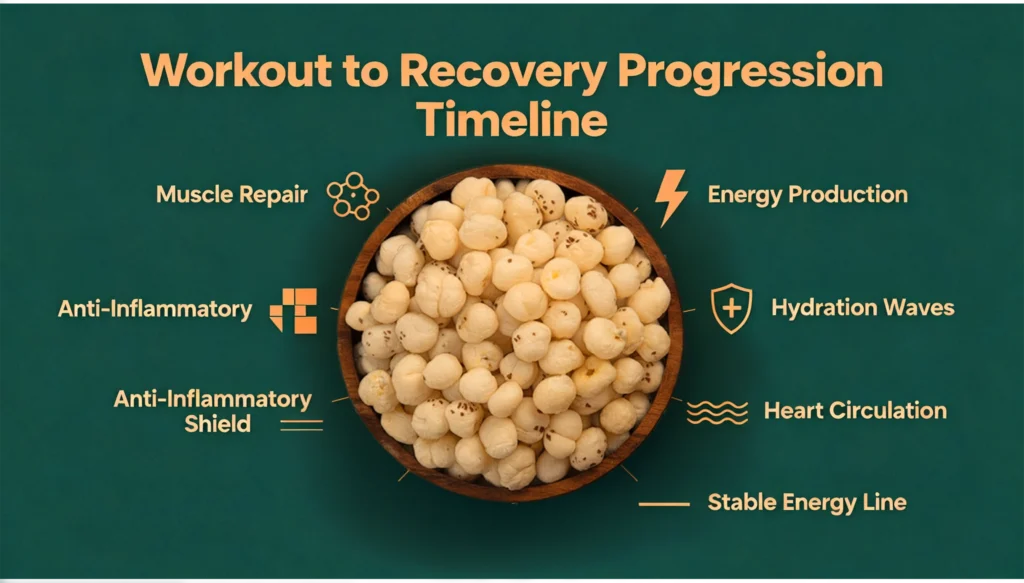
The Recovery Timeline: 6-Hour Post-Workout Window Explained
Understanding what happens to your body after training helps explain why makhana’s timing and composition matter so much.
Minute 0-15: The Metabolic Shock
Your nervous system is still elevated. Your muscles are still warm. Lactate is still accumulating. Your body hasn’t yet realized exercise has ended.
What to do: Hydrate with plain water. 200-300ml is sufficient. Avoid heavy food.
Minute 15-60: The Optimal Nutrition Window
This is when your body is most receptive to nutrient uptake. Muscle protein synthesis rates are 50-100% elevated. Glycogen restoration is maximized. Electrolytes are most efficiently absorbed.
What to do: Consume makhana + protein + carbs within this window. This is when the 3g protein and 23g carbs from makhana work most effectively.
What happens:
- Glycogen restoration initiates (carbs trigger insulin release, driving glucose into muscles)
- Amino acids begin circulating (protein synthesis peaks)
- Minerals begin replenishing (magnesium, phosphorus incorporated into muscle and energy pathways)
Hour 1-2: Secondary Recovery Phase
The acute “must consume now” pressure has passed. But recovery is still accelerating.
What to do: Consume a complete meal (protein + carbs + vegetables). If you ate makhana immediately post-workout, this could be your actual lunch/dinner meal.
What happens:
- Glycogen restoration continues (but at slower rate than first hour).
- Muscle protein synthesis remains elevated (but declining from peak).
- Anti-inflammatory processes begin (if you consumed antioxidants with first meal).
Hour 2-4: Sustained Recovery Phase
You’re past the “golden window,” but recovery is still actively occurring.
What to do: Normal eating. Ensure adequate total daily protein (doesn’t have to be single meal), hydration, and sleep.
What happens:
- Glycogen restoration gradually completes
- Muscle protein synthesis returns toward baseline (but elevated compared to pre-exercise)
- Inflammation management continues
- Micronutrient absorption and utilisation are optimised
Hour 4-6: Restoration Completion
Most acute recovery has been completed. Long-term adaptations (muscle building, mitochondrial improvements) now depend on consistent training + nutrition + sleep.
What to do: Regular meals. Adequate sleep (where most recovery actually happens).
Real-World Example: Priya’s 90-Minute CrossFit Session
| Time | Action | Why |
|---|---|---|
| 0:00 | Workout ends | Acute recovery begins |
| 0:15 | 300ml water | Rehydration without digestive load |
| 0:30 | 30g makhana + 150g yogurt + berries | Optimal nutrient timing |
| 1:30 | Lunch (chicken + rice + vegetables) | Secondary recovery + normal eating resumption |
| 3:00 | Snack (makhana trail mix) | Sustained energy + continued mineral intake |
| 6:00 | Sleep optimization | Where 40% of actual recovery happens |
In this timeline, makhana appears twice—immediately post-workout (when it matters most) and as a sustained snack (when it supports continued recovery).
The Bottom Line: Why Makhana Is the Athlete’s Secret
Here’s what separates athletes who get results from those who plateau:
- Basic approach: Train hard, take supplements, hope for results.
- Better approach: Train intelligently, fuel strategically, recover systematically.
Makhana doesn’t replace training. It doesn’t replace sleep. It doesn’t replace consistency.
But makhana provides the nutritional foundation that lets your training, sleep, and consistency actually translate into results.
Here’s what you get with strategic makhana use:
- ✓ 3g protein per serving – Supports muscle protein synthesis, especially post-workout with carbs.
- ✓ 23g complex carbs per serving – Restores glycogen without blood sugar crash.
- ✓ 67mg magnesium per 100g – Reduces soreness, improves recovery speed.
- ✓ 500mg potassium per 100g – Maintains electrolyte balance, prevents cramps.
- ✓ Resistant starch – 10% improved endurance, faster gut-bacteria-mediated recovery.
- ✓ Zero additives – No artificial sweeteners, no processing damage, no digestive distress.
- ✓ ₹12-15 per serving – Cost-effective compared to protein powders (₹30-50) and sports drinks (₹40-80).
- ✓ 100% whole food – Your body recognises it, absorbs it efficiently, uses it optimally.
Rohan went from struggling to complete workouts, spending ₹8,000 monthly on supplements, and recovering slowly, to improved cycling times, dropping to ₹1,200 in nutrition costs, and recovering faster than ever.
That’s not luck. That’s smart nutrition applied consistently.
Your Action Plan: Starting This Week
If you’re currently using protein powder and sports drinks:
- Replace 50% of your post-workout protein powder with makhana-based recovery meals.
- Reduce sports drink consumption for training under 60 minutes (use water + makhana).
- Track results for 4 weeks.
If you’re just starting your fitness journey:
- Make makhana your post-workout default (30g + yogurt + fruit).
- Pre-workout: Banana + honey (simpler, more effective than complex supplements).
- In-between meals: Makhana trail mix for sustained energy.
If you’re an endurance athlete:
- Use makhana during multi-hour training (resistant starch improves endurance).
- Post-workout: Large makhana-based meal with substantial carbs.
- Daily: Makhana in multiple meals for sustained micronutrient intake.
Realistic Expectations:
- Week 2-3: Noticeable reduction in muscle soreness.
- Week 4-6: Stable energy throughout the day, no 4 p.m. crashes.
- Week 8-12: Performance improvements (faster times, more strength, better endurance).
- Month 4+: Consistent recovery supporting greater training frequency/intensity.
The Athlete’s Advantage
When Rohan discovered makhana, he wasn’t looking for a miracle. He was looking for something simple, effective, and sustainable.
What he found was something his grandmother probably knew all along: The best nutrition isn’t flashy. It’s not sold by influencers. It doesn’t require constant reordering of the latest supplement.
The best nutrition is whole foods that are actually designed for what your body needs.
Explore Samaza’s Premium Roasted Makhana and start building your recovery routine on science-backed, whole-food nutrition.
Because performance isn’t about training harder. It’s about recovering smarter.
Your results are waiting. Everything you need is in a 30-gram serving.
What’s your post-workout nutrition routine like right now? Share in the comments—we’d love to hear what’s working for you and how makhana could optimize your recovery even further.
Track your results. Try makhana for 4 weeks. Monitor your soreness, energy, and performance. Share your transformation story with the community.