
Samaza | Premium Makhana Manufacturer & Bulk Supplier India

Pure Ingredients. Honest Origins

Samaza B2B

This category covers all B2B business related posts and blogs

From Pond to Pearl: The Samaza Process

Quality Isn’t a Single Action; It’s a Meticulous Journey. We Honor the Craft and the Community Behind Every Makhana   In a world obsessed with speed, Samaza moves differently. Every makhana pearl that reaches your table carries within it months of careful intention, generations of farming wisdom, and an unwavering commitment to quality that begins not in a factory, but in the wetlands of Bihar—where tradition meets sustainability most beautifully. This is the story of how a simple seed becomes something extraordinary. This is the Samaza process. Ethical Harvesting: Where Community and Sustainability Begin The journey of every Samaza makhana starts not with machines, but with people. We partner directly with traditional farming communities across Bihar’s wetlands, communities whose families have been cultivating makhana for generations—long before industrial agriculture existed, long before profit margins were measured in quarters.  A Living Legacy These aren’t just suppliers; they’re stewards of an ancient craft. The farmers who harvest our makhana understand something that modern agriculture has largely forgotten: the land is not a resource to extract from, but a partner to collaborate with. Their harvesting practices have been refined over centuries, passed down from grandmothers to grandsons, each generation learning to read the wetlands the way a musician reads sheet music.  The Harvesting Season When the makhana plants bloom in late summer and early autumn, the harvest begins. It’s physically demanding work—farmers wade into the shallow waters, their hands moving with practiced precision to identify ripe seed pods just beginning to ripen. There’s no rush. There’s no rushing. Each pod is hand-selected at peak maturity, ensuring that only the healthiest, most developed seeds enter our supply chain. This selective harvesting—done entirely by hand—is radically different from industrial approaches. It’s slower. It’s more expensive. It’s also the only way to ensure the consistent quality that defines Samaza. Protecting the Ecosystem But here’s what makes this truly different: our harvesting practices strengthen the wetlands rather than deplete them. The makhana plants themselves are nitrogen-fixing—they actually improve soil health. The wetlands become more resilient, more biodiverse, more capable of supporting fish, birds, and countless species that depend on these ecosystems. When you eat Samaza makhana, you’re not just nourishing yourself. You’re supporting a system that keeps ancient wetlands alive, that keeps farming communities economically viable, that honors both the earth and the people who tend it.  Natural Curing: The Patience That Creates Perfection Once harvested, the makhana seeds embark on a phase that most modern food production would skip or rush: curing. This is where magic begins to happen, where science and patience intertwine, where the seed is transformed from its raw potential into something ready for the next stage of its journey.  Sun, Time, and Tradition The harvested seeds are spread across large, open spaces—traditionally on woven mats or natural drying beds—where they’re exposed to the sun in a carefully controlled manner. This isn’t random sun-drying. This is intentional curing, a process guided by generations of knowledge about humidity levels, temperature fluctuations, and the precise timeline needed for optimal seed development. During this phase, the seed’s internal moisture content gradually decreases. The shell begins to harden. The inner kernel develops its characteristic texture and nutritional density. It’s a slow transformation—one that cannot be rushed without compromising quality.  Why This Matters In conventional food production, this stage is often accelerated with heat or chemicals. Seeds are dried artificially in controlled chambers designed for speed rather than quality. The result? Seeds that pop, yes, but seeds that lack the profound texture, the delicate crispness, the subtle flavor that makes Samaza makhana distinctive. Our natural curing process takes longer. It requires more space, more monitoring, more coordination with weather patterns. It’s inefficient by modern standards. It’s also essential—because this patient, natural transformation is what prepares the seed for the final alchemy: the roasting.  A Sensory Experience When you hold a naturally cured Samaza makhana in your hand, you can feel the difference. The seed is lighter, almost weightless. The shell has a slight translucency if you hold it to the sun. There’s a subtle sweetness in the aroma—the scent of something that has been allowed to mature fully, rather than something processed into submission. The ‘Perfect Pop’: Where Artistry Meets Precision Now comes the moment of transformation that defines the entire Samaza experience: the roasting. This is where a cured seed becomes a pearl—where careful preparation meets the precise artistry of our roasting masters.  The Art and Science of Roasting Roasting makhana is not a science that can be reduced to temperature settings and timer algorithms. It’s an art form that requires intuition, experience, and respect for the ingredient. Our roasters are trained over years, learning to read the subtle signals that tell them when a batch has reached perfection. The roasting happens in small batches—never large, industrial quantities. Each batch is roasted in traditional methods, often using methods that have been used for generations. The temperature is precise (around 180-200°C, depending on the batch’s moisture content and the desired pop size), but the true indicator of readiness isn’t a clock. It’s the roaster’s eye, ear, and nose.  The Moment of Pop When the conditions align perfectly, something extraordinary happens: the seed pops. The moisture inside the kernel rapidly transforms, creating internal pressure that causes the outer shell to rupture dramatically and expand into a light, crispy pearl. It’s a moment of sudden transformation—the culmination of months of careful cultivation and processing. But here’s the secret most people don’t know: not every seed pops perfectly. Some pop too large. Some don’t pop at all. Some pop unevenly. In industrial operations, these imperfect pops are often mixed back in, sorted by machines, or simply included in the final product. The consumer never knows the difference because they’re not eating artisanal makhana; they’re eating a commodity. At Samaza, this is where the next phase begins: the grading.  Temperature, Timing, Texture The precision required here is extraordinary. A difference of just 5-10 degrees can mean the difference between a perfect

From Pond to Pearl: The Samaza Process Read More »
Makhana Grades Explained: 4, 5, 6 Suta & How to Choose

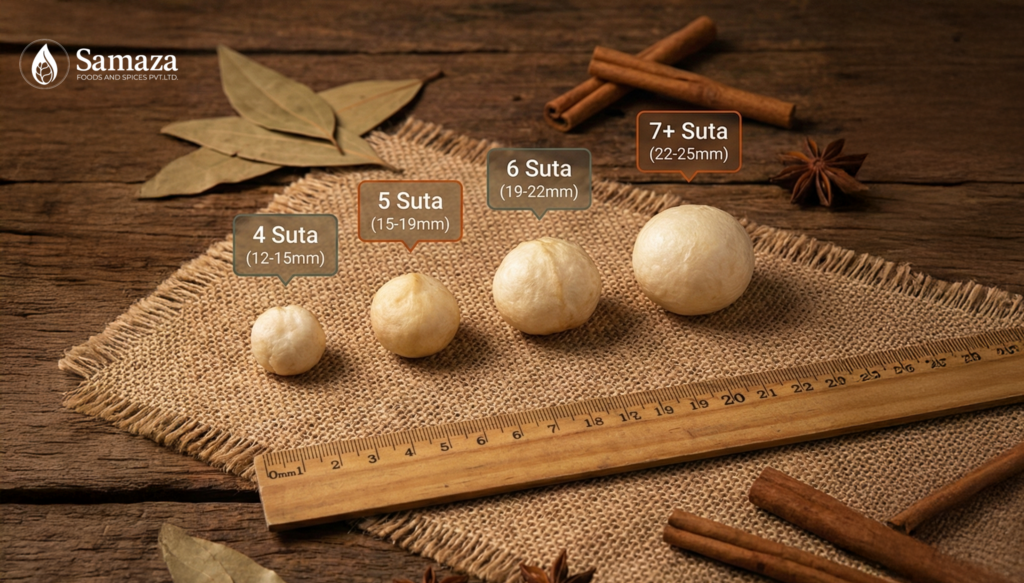
Your Complete Guide to Understanding Makhana Quality Grades—And Picking the Right One For Your Needs Introduction: Why Makhana Grades Matter (And Why Nobody Explains Them) You’re looking at a makhana package, and you see “5-sutta” or “6-sutta” written on it. What does that actually mean? Why does it matter? And more importantly, which one should you buy? If you’ve felt confused by makhana grading, you’re not alone. The sutta system isn’t documented well, and most sellers use it without explaining what it means. This leads to frustrated buyers—people paying more than they should for grades they don’t need, or buying cheaper grades that disappoint them. Let’s fix that. This guide explains makhana grades in plain language. We’ll walk through what each grade actually means, who each grade is perfect for, how long each lasts, and how to store them properly. By the end, you’ll know exactly which grade to buy for your specific use case. What is “Suta”? Understanding the Grading System “Sutta” is the traditional grading measurement for makhana. It refers to the number of makhana pearls per 100 grams. Here’s how it works: 4-Suta: Approximately 4 large pearls per gram = roughly 400 pearls per 100g (largest size) 5-Suta: Approximately 5 medium-large pearls per gram = roughly 500 pearls per 100g (medium-large) 6-Suta: Approximately 6 medium pearls per gram = roughly 600 pearls per 100g (standard/most common) Think of it this way: Lower sutta number = Larger pearls. Higher sutta number = Smaller pearls. The grading system is based on size consistency and pearl count. It’s a traditional measurement that still works perfectly for understanding what you’re buying The Three Main Grades: What Each Actually Means Grade 1: 4-Suta Makhana (Premium/Luxury Grade) What it looks like: Large, uniform pearl size. Each pearl is noticeably chunky and substantial. Visual consistency is excellent—all pearls look nearly identical in size. Pop quality: Fully popped, perfect structure, no unpopped or broken pearls in premium batches. Best described as: “The luxury makhana.” Perfect for: Gifting (it looks impressive, feels premium) Special occasions (festive trays, premium gifting) Snacking for enjoyment (large pearls feel more satisfying) Premium retail packaging (luxury positioning) Restaurant premium positioning (looks impressive on the plate) Why it costs more: Larger pearls are harder to achieve consistently Higher defect rate in sourcing (smaller imperfect pearls are removed) Requires stricter quality control More effort in sorting and grading Taste & Texture: Identical to other grades (makhana is makhana), but the experience feels premium because pearls are larger and more substantial. Shelf Life: 8-12 months (in proper storage) Storage: Cool, dry place (below 25°C, humidity below 60%) Grade 2: 5-Suta Makhana (Standard Premium Grade) What it looks like: Medium-large, uniform pearl size. Pearls are noticeably larger than standard makhana but smaller than 4-sutta. Visual consistency is very good—slight size variation is normal and acceptable. Pop quality: Well-popped, minimal unpopped seeds, minimal breakage. Quality is excellent. Best described as: “The balance—premium quality at a reasonable price.” Perfect for: Regular home snacking (personal consumption) Family gifting (nice presentation without luxury pricing) Small restaurant/café uses (looks good, costs reasonable) Healthy snack boxes (professional appearance) Institutional use (schools, offices—quality without excessive cost) Your own consumption (cost-effective premium quality) Why it’s popular: This is the sweet spot. You get genuine quality and good visual presentation without paying luxury prices. Most people buying makhana for themselves choose this grade. Taste & Texture: Identical to all grades—makhana is makhana. But 5-suta feels more satisfying than 6-suta because pearls are larger. Shelf Life: 8-12 months (in proper storage) Storage: Cool, dry place (below 25°C, humidity below 60%) Grade 3: 6-Sutta Makhana (Standard Grade) What it looks like: Medium pearl size, more compact appearance. This is the most common makhana you see in retail. Size variation is slightly more noticeable than premium grades, but consistency is still good. Pop quality: Good quality—well-popped, acceptable defect rate. Occasional broken pearl or unpopped seed, but not excessive. Best described as: “The everyday makhana.” Perfect for: Budget-conscious snacking (you’re eating it, not gifting it) High-volume institutional catering (large events, bulk orders) Manufacturing/food production (used as ingredient in other products) Baking/cooking (when final size doesn’t matter) Grinding into flour (size doesn’t matter for flour) Testing before committing to larger quantities (trying makhana for the first time) Students, budget shoppers (you want good quality at lower cost) Why it’s cheapest: Smaller pearls are easier to produce consistently. Defect sorting is less rigorous. You pay for what you get—good makhana at a fair price. Taste & Texture: Identical to other grades. The experience is slightly less luxurious because pearls are smaller, but the nutritional value and taste are identical. Shelf Life: 6-10 months (in proper storage) Storage: Cool, dry place (below 25°C, humidity below 60%) Visual Comparison: What Each Grade Actually Looks Like Aspect 4-Suta 5-Suta 6-Suta Pearl Size Large (obviously bigger) Medium-large (comfortably sized) Medium (compact) Pearls per 100g ~400 ~500 ~600 Visual Appearance Premium, impressive Professional, balanced Practical, everyday Size Consistency Extremely uniform Very uniform Good uniformity Defect Rate <1% 1-2% 2-3% Pop Quality Perfect Excellent Good Price Relative to 6-Sutta +40-50% +15-25% Baseline “Wow” Factor High (impressive) Medium (nice) Low (practical) Use-Case Framework: Which Grade Is Right For You? Use Case 1: Gifting Scenario: You want to gift makhana to friends or family. Recommendation: Premium gifting (want to impress): 4-Suta Nice gifting (good impression): 5-Suta Budget gifting (want quality without overspending): 6-Suta Why: Larger pearls look more impressive. When someone opens a gift, they judge partly by visual appearance. Larger pearls make makhana look more luxurious. Pro Tip: 5-Suta is the sweet spot for gifting—it looks premium without requiring luxury pricing. Use Case 2: Personal Snacking Scenario: You’re buying for yourself—daily snacking, healthy eating. Recommendation: Want the best experience: 5-Suta Budget-conscious: 6-Suta Really love makhana: 4-Suta (treat yourself) Why: For personal consumption, you’re choosing based on preference and budget. 5-Suta feels most satisfying because the pearls are larger. 6-Suta is perfectly good—just slightly less luxurious feeling. 4-Sutta is only necessary if you’re treating makhana as a luxury snack. Pro Tip: Buy 500g of 5-Suta to try. It’s the Goldilocks of makhana—not too expensive, but noticeably better than

Makhana Grades Explained: 4, 5, 6 Suta & How to Choose Read More »