
Quality Isn’t a Single Action; It’s a Meticulous Journey. We Honor the Craft and the Community Behind Every Makhana
In a world obsessed with speed, Samaza moves differently. Every makhana pearl that reaches your table carries within it months of careful intention, generations of farming wisdom, and an unwavering commitment to quality that begins not in a factory, but in the wetlands of Bihar—where tradition meets sustainability most beautifully.
This is the story of how a simple seed becomes something extraordinary. This is the Samaza process.
Ethical Harvesting: Where Community and Sustainability Begin
The journey of every Samaza makhana starts not with machines, but with people. We partner directly with traditional farming communities across Bihar’s wetlands, communities whose families have been cultivating makhana for generations—long before industrial agriculture existed, long before profit margins were measured in quarters.
A Living Legacy
These aren’t just suppliers; they’re stewards of an ancient craft. The farmers who harvest our makhana understand something that modern agriculture has largely forgotten: the land is not a resource to extract from, but a partner to collaborate with. Their harvesting practices have been refined over centuries, passed down from grandmothers to grandsons, each generation learning to read the wetlands the way a musician reads sheet music.
The Harvesting Season
When the makhana plants bloom in late summer and early autumn, the harvest begins. It’s physically demanding work—farmers wade into the shallow waters, their hands moving with practiced precision to identify ripe seed pods just beginning to ripen. There’s no rush. There’s no rushing. Each pod is hand-selected at peak maturity, ensuring that only the healthiest, most developed seeds enter our supply chain.
This selective harvesting—done entirely by hand—is radically different from industrial approaches. It’s slower. It’s more expensive. It’s also the only way to ensure the consistent quality that defines Samaza.
Protecting the Ecosystem
But here’s what makes this truly different: our harvesting practices strengthen the wetlands rather than deplete them. The makhana plants themselves are nitrogen-fixing—they actually improve soil health. The wetlands become more resilient, more biodiverse, more capable of supporting fish, birds, and countless species that depend on these ecosystems.
When you eat Samaza makhana, you’re not just nourishing yourself. You’re supporting a system that keeps ancient wetlands alive, that keeps farming communities economically viable, that honors both the earth and the people who tend it.
Natural Curing: The Patience That Creates Perfection
Once harvested, the makhana seeds embark on a phase that most modern food production would skip or rush: curing. This is where magic begins to happen, where science and patience intertwine, where the seed is transformed from its raw potential into something ready for the next stage of its journey.
Sun, Time, and Tradition
The harvested seeds are spread across large, open spaces—traditionally on woven mats or natural drying beds—where they’re exposed to the sun in a carefully controlled manner. This isn’t random sun-drying. This is intentional curing, a process guided by generations of knowledge about humidity levels, temperature fluctuations, and the precise timeline needed for optimal seed development.
During this phase, the seed’s internal moisture content gradually decreases. The shell begins to harden. The inner kernel develops its characteristic texture and nutritional density. It’s a slow transformation—one that cannot be rushed without compromising quality.
Why This Matters
In conventional food production, this stage is often accelerated with heat or chemicals. Seeds are dried artificially in controlled chambers designed for speed rather than quality. The result? Seeds that pop, yes, but seeds that lack the profound texture, the delicate crispness, the subtle flavor that makes Samaza makhana distinctive.
Our natural curing process takes longer. It requires more space, more monitoring, more coordination with weather patterns. It’s inefficient by modern standards. It’s also essential—because this patient, natural transformation is what prepares the seed for the final alchemy: the roasting.
A Sensory Experience
When you hold a naturally cured Samaza makhana in your hand, you can feel the difference. The seed is lighter, almost weightless. The shell has a slight translucency if you hold it to the sun. There’s a subtle sweetness in the aroma—the scent of something that has been allowed to mature fully, rather than something processed into submission.
The ‘Perfect Pop’: Where Artistry Meets Precision
Now comes the moment of transformation that defines the entire Samaza experience: the roasting. This is where a cured seed becomes a pearl—where careful preparation meets the precise artistry of our roasting masters.
The Art and Science of Roasting
Roasting makhana is not a science that can be reduced to temperature settings and timer algorithms. It’s an art form that requires intuition, experience, and respect for the ingredient. Our roasters are trained over years, learning to read the subtle signals that tell them when a batch has reached perfection.
The roasting happens in small batches—never large, industrial quantities. Each batch is roasted in traditional methods, often using methods that have been used for generations. The temperature is precise (around 180-200°C, depending on the batch’s moisture content and the desired pop size), but the true indicator of readiness isn’t a clock. It’s the roaster’s eye, ear, and nose.
The Moment of Pop
When the conditions align perfectly, something extraordinary happens: the seed pops. The moisture inside the kernel rapidly transforms, creating internal pressure that causes the outer shell to rupture dramatically and expand into a light, crispy pearl. It’s a moment of sudden transformation—the culmination of months of careful cultivation and processing.
But here’s the secret most people don’t know: not every seed pops perfectly. Some pop too large. Some don’t pop at all. Some pop unevenly. In industrial operations, these imperfect pops are often mixed back in, sorted by machines, or simply included in the final product. The consumer never knows the difference because they’re not eating artisanal makhana; they’re eating a commodity.
At Samaza, this is where the next phase begins: the grading.
Temperature, Timing, Texture
The precision required here is extraordinary. A difference of just 5-10 degrees can mean the difference between a perfect pop and a ruined batch. Roast too quickly, and the seed won’t fully pop. Roast too slowly, and you create dense, heavy pearls that lack the characteristic crispness. The roasting masters at Samaza have developed an almost supernatural ability to sense when a batch has reached the exact moment of perfection.
And they do this—all of it—with traditional methods. No automated roasters. No pre-set programs. Just expertise, attention, and an unwavering commitment to the craft.
Rigorous Grading: The Standard That Defines Excellence
After roasting comes the phase that most consumers never see but that defines whether a product is truly premium or simply “good enough”: grading.
The Hand-Sort
Every. Single. Makhana. Is. Hand-sorted.This is not hyperbole. This is our actual process. After roasting, the makhana is passed to our grading artisans—skilled workers who have been trained to evaluate each pearl across multiple dimensions: size, color, texture, density, and overall aesthetic quality.
These aren’t people scanning items on an automated line. These are craftspeople with an intuitive understanding of quality, people who can feel the difference between a perfectly popped pearl and one that’s marginally off in ways that machines cannot detect.
The Four Dimensions of Grading
Size Consistency: Makhana pearls are sorted into specific size grades. This isn’t just about aesthetics—size consistency also ensures even cooking and uniform texture in recipes. A mix of large and small pearls will cook inconsistently; some will become crispy while others remain slightly chewy.
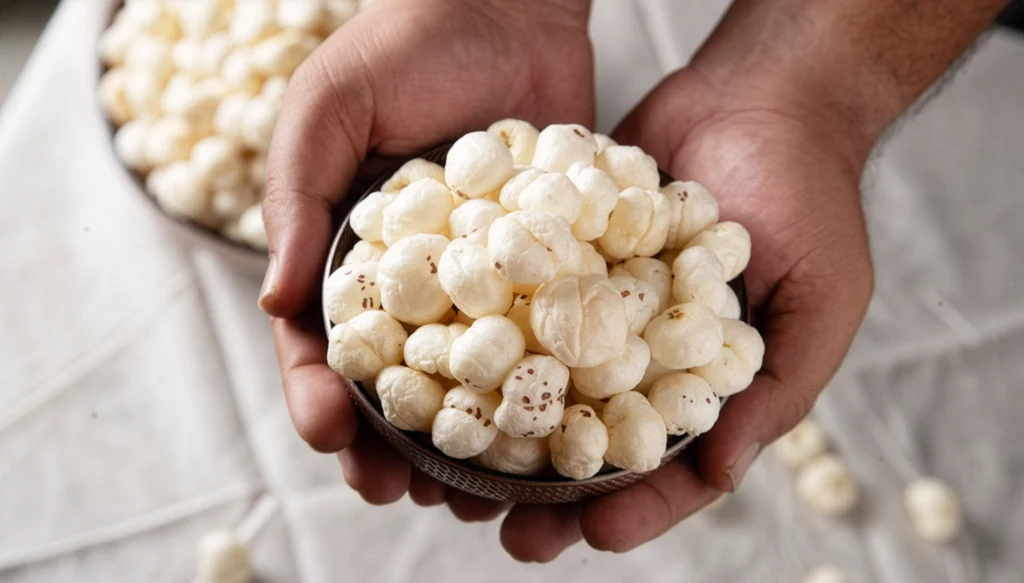
Color Purity: We grade by color intensity and purity. The finest Samaza makhana has a pure, creamy white appearance—no discoloration, no browning, no imperfections. Our graders can identify subtle color variations that consumers might not consciously notice but will definitely feel in their overall sensory experience.
Texture Excellence: Each pearl is evaluated for texture. Is the shell crispy throughout? Is there any sogginess or density? Is the internal structure light and airy? Only pearls that meet our exacting standards pass through.
Overall Aesthetic: Beyond these individual metrics, there’s a holistic judgment. Does this pearl belong in a Samaza package? Does it represent our commitment to excellence? If any of our graders have even a slight doubt, the pearl is removed.
The Rejection Rate
Here’s what most food companies won’t tell you: a significant percentage of their production doesn’t meet their stated quality standards. But because those standards are loose, and because most consumers don’t know what true quality looks like, those sub-standard products get packaged and sold anyway.
At Samaza, our rejection rate for pearls that don’t meet standards is higher than most companies’ acceptance rate. We remove pearls that would be considered “perfectly fine” by most producers. We remove pearls that are only marginally imperfect. We remove pearls that don’t align with our vision of what Samaza represents.
This commitment costs us money. It reduces our yield. It makes our production more expensive. It’s also non-negotiable—because quality isn’t something you negotiate. It’s something you commit to, completely and without compromise.
The Consistency Promise
When you open a package of Samaza makhana, you’re not opening a grab bag of “pretty good” pearls mixed with some that are merely adequate. You’re opening a collection of pearls that have each been individually assessed and approved by human judgment trained through years of experience.
This is why Samaza makhana tastes different. Feels different. Looks different. Every pearl in your bowl has been vetted as worthy of the Samaza name.
The Philosophy Behind the Process
Every step of the Samaza process—from ethical harvesting through rigorous grading—reflects a deeper philosophy about what quality means and why it matters.
Quality as Respect
First and foremost, our process is an expression of respect. Respect for the farmers whose families have stewarded these wetlands for generations. Respect for the ingredient itself—a humble seed that deserves to be treated with dignity, not rushed through assembly lines designed for volume. Respect for the artisans whose skills make the transformation possible. And ultimately, respect for you—our customer—who deserves food that genuinely reflects the care we claim to provide.
This respect isn’t performative. It’s embedded in every decision, every process, every standard we maintain. When a roaster slows down a batch because something doesn’t feel quite right, that’s respect. When a grader removes a marginally imperfect pearl, that’s respect. When we partner directly with farming communities and ensure they’re fairly compensated, that’s respect.
Sustainability as Responsibility
Our commitment to sustainable harvesting practices isn’t separate from our quality commitment—it’s foundational to it. We understand that short-term profit maximization that depletes ecosystems ultimately destroys the very foundation our business depends on. By protecting the wetlands, by
strengthening ecosystems, by supporting farming communities’ long-term viability, we’re investing in a future where Samaza makhana can continue to be exceptional for generations to come.
Transparency as Trust
We share this process with you not because it’s a marketing strategy, but because we believe you deserve to know where your food comes from and how it’s made. We want you to understand the journey your makhana has taken, the people who made it possible, the standards we’ve maintained. This transparency is how we earn your trust—not through promises, but through accountability.
The Result: From Pond to Pearl to Your Table
When you choose Samaza makhana, you’re not just buying a snack. You’re participating in a system that honors craftsmanship, that protects ecosystems, that supports farming communities, that maintains uncompromising standards of quality.
Every pearl in your bowl represents:
- Months of patient cultivation by farmers dedicated to sustainable practices
- Generations of knowledge about how to work with the land rather than against it
- Expert artistry in the roasting process, guided by intuition and experience
- Individual assessment by trained graders ensuring only the finest pearls reach you
A commitment to your wellbeing that goes far beyond what’s legally required
This is what quality looks like when you’re willing to do things the right way, even when the easy way is available.
This is the Samaza promise—from pond to pearl, quality woven into every step.
Join Us in Honoring the Craft
When you choose Samaza makhana, you’re voting with your choices. You’re saying that quality matters more than convenience. You’re saying that the stories behind your food matter. You’re saying that supporting sustainable farming communities is worth paying a little more.
You’re saying that pearls—real pearls—are worth the journey. Experience the difference. Taste the commitment. This is Samaza.