
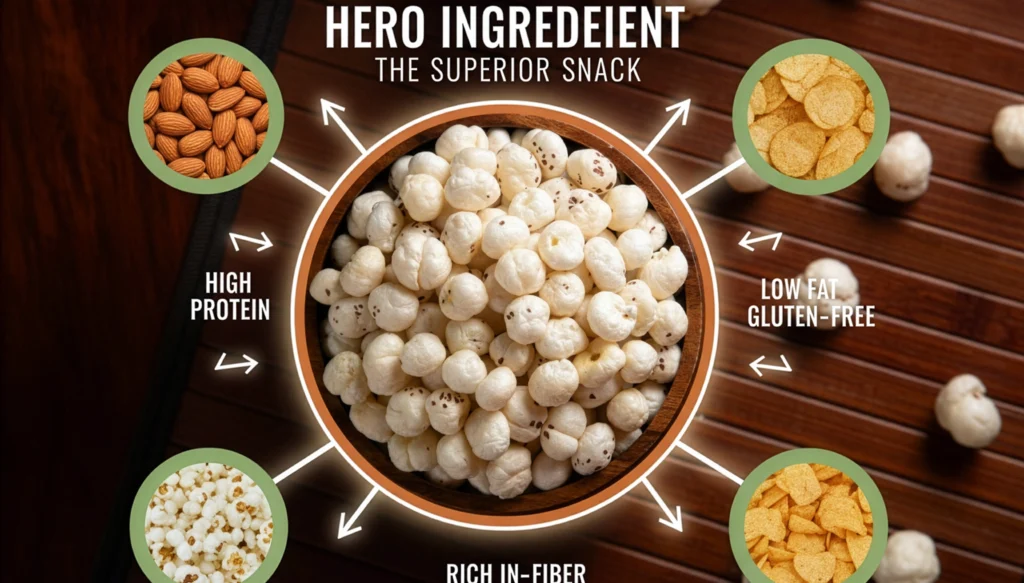
The Truth Behind 10 Common Misconceptions About India’s Most Misunderstood Superfood
If you’ve scrolled through wellness content in the past few years, you’ve probably encountered makhana. You might have seen it in smoothie bowls, clicked on an article about its health benefits, or heard a friend rave about how full they stayed after eating it. And you might have immediately thought one of several things: “That sounds too good to be true,” “It’s probably expensive,” “Doesn’t it taste like nothing?” or even “Isn’t that just for fasting?”
Welcome to the world of makhana myths—and you’re not alone in wondering about them.
The truth is, makhana has been surrounded by misconceptions for years. Some stem from legitimate gaps in knowledge. Others are born from outdated information, influencer oversimplification, or the natural skepticism we all bring to wellness trends. And honestly? Many of these myths exist because makhana’s actual story—its nutrition, its versatility, its proven benefits—is so remarkable that it sounds too good to be true.
But here’s what we’ve learned in building Samaza: the real story is even better than the hype. And it’s time to set the record straight.
Let’s debunk 10 of the most persistent myths about makhana with evidence, expert insight, and real stories from people who were once skeptical themselves.
MYTH #1: “Makhana is Too Expensive to Include Regularly”
Why People Believe It
Makhana has long been positioned as a premium ingredient—and for good reason. Quality makhana requires careful harvesting, expert roasting, and rigorous grading. This craftsmanship comes at a cost, and yes, makhana can be more expensive than some mass-produced snacks. When you see a premium package at a specialty store, the sticker shock can make you think: “I can’t afford to eat this regularly.”
The Fact-Based Counter-Argument
Here’s where we need to look at cost-per-serving rather than just package price. One serving of makhana (typically 1/4 cup or about 30 grams) costs approximately ₹15-25, depending on where you buy and the quality level. Compare that to:
- Premium coffee drink: ₹80-150 per serving
- Store-bought healthy snack bars: ₹60-120 per bar
- Organic chips or crackers: ₹40-80 per serving
- Protein powders: ₹50-100 per shake
- Nuts and seeds: ₹30-60 per serving
When you look at the actual cost-per-serving, makhana is remarkably affordable for what you’re getting. And if you buy in bulk directly from quality producers like Samaza, the per-serving cost drops even further. Over a year, a daily makhana snack habit costs you approximately ₹5,000-9,000—about ₹1,200-2,000 per month—compared to most premium wellness snacks that run ₹3,000-5,000 monthly for individuals following consistent routines.
Expert Perspective: “When evaluating food costs, consumers often fixate on absolute price rather than value per serving and nutrient density. Makhana offers exceptional nutrient density at a reasonable price point when compared to conventional premium snacks,” says Dr. Asha Sharma, Registered Dietitian and Nutrition Economist.
Real Story
“I was intimidated by the price at first,” admits Priya, 34, a marketing professional from Bangalore. “I thought it was a luxury snack I could only afford occasionally. Then I calculated what I was spending on coffee runs and packaged snacks—easily ₹400-500 per week. I switched to buying Samaza makhana in bulk, and my weekly snack budget actually went down while my nutrition went up. I’ve been eating it daily for two years now, and I can’t imagine my pantry without it.”
Actionable Takeaway
Buy makhana in bulk during sales or from direct sources. One 500g package costs about ₹400-600 but provides 15-17 servings, bringing the per-serving cost to approximately ₹25-40. Even at this price, it’s competitive with most premium snacks. Try it for one month and calculate your actual cost compared to your previous snacking habits.
MYTH #2: “Makhana is Boring and Tasteless”
Why People Believe It
This myth likely stems from experiencing poorly processed or stale makhana, or eating plain roasted makhana without any seasoning. When your only exposure to makhana is a bland handful of pearls, of course, it seems boring. Additionally, makhana’s subtle, neutral flavor (which is actually one of its greatest strengths) can feel underwhelming compared to intensely flavored snacks designed to trigger maximum taste satisfaction through salt, sugar, and fat.
The Fact-Based Counter-Argument
Makhana’s neutral flavor profile isn’t a weakness—it’s an asset. This is precisely why makhana works in both sweet and savory applications, in smoothies and risottos, in granola and curries. Fresh, properly roasted makhana has a delicate, slightly sweet, nutty undertone that’s genuinely pleasant. The issue isn’t makhana’s taste; it’s that most people have only experienced it plain.
Consider these flavor applications:
- Savory roasted makhana: Toss with olive oil, sea salt, and zaatar spice for Middle Eastern-inspired crunch
- Chaat-style makhana: Mix with sev, tomatoes, onions, and chaat masala for Indian street food vibes
- Chocolate-covered makhana: Dip in dark chocolate and sea salt for dessert-snack sophistication
- Curried makhana: Cook in coconut milk and curry paste for complex, satisfying depth
- In cold coffee: The subtle sweetness complements espresso beautifully
Expert Perspective: Chef Rohan Desai, culinary instructor and wellness food specialist, says: “Makhana is like a culinary blank canvas. It absorbs whatever flavors you pair it with while maintaining its structural integrity. I’ve used it in everything from Thai curries to Italian risottos to Indian desserts. Its versatility is remarkable, and its subtle natural sweetness actually enhances rather than competes with other flavors.”
Real Story
“I tried plain makhana once and thought, ‘Never again,'” laughs Amit, 28, a software engineer from Pune. “It was like eating air, honestly. Then a friend made me these amazing curry makhana with coconut milk and spices, and I was shocked. I started experimenting with different seasonings, and now I have a rotation of five different flavor profiles I rotate through. My favorite is the chaat-style version with chutney. Boring? Absolutely not.”
Actionable Takeaway
Don’t judge makhana based on plain roasted pearls. Try it in at least three different flavor applications: one savory seasoned version, one sweet or dessert application, and one integrated into a dish like risotto or curry. You’ll discover that makhana takes on whatever flavor profile you create.
MYTH #3: “Makhana Won’t Keep You Full”
Why People Believe It
Makhana is light and crispy—it doesn’t have the dense heft of nuts or the starchy satisfaction of chips. When something feels airy and low-calorie, our brains sometimes equate that with low satiety. Additionally, if someone snacked on a small handful of makhana as a between-meal treat, they might have experienced hunger again quickly, reinforcing the myth that it’s not truly filling.
The Fact-Based Counter-Argument
The science of satiety involves multiple factors: protein content, fiber content, volume, and how quickly the food is digested. Makhana excels in all of these areas:
Nutritional Profile (per 100g):
- Protein: 10-13g (high for a snack)
- Fiber: 8-10g (exceptional—most snacks have 1-2g)
- Water content: Naturally low, meaning you consume fewer empty calories for the same satiation
- Glycemic Index: Low (35-50), meaning no blood sugar crash and sustained fullness
The combination of high protein, high fiber, and low glycemic index creates what’s scientifically called “sustained satiety”—fullness that lasts. Studies on plant-based proteins and fiber consistently show that combinations like these keep people satisfied 2-3 hours, compared to processed snacks that maintain satisfaction for 45-60 minutes.
Additionally, the volume of makhana matters. A 30g serving of makhana looks substantial in a bowl—it’s visually satisfying in a way that a 30g serving of nuts isn’t. This visual satiation is a genuine component of how our brains perceive fullness.
Expert Perspective: Dr. Meera Patel, Nutritionist specializing in satiety and sustainable weight management, explains: “Makhana’s combination of protein, fiber, and complex carbohydrates creates what we call ‘complete satiety.’ It addresses multiple hunger mechanisms simultaneously. The protein signals to your brain that you’ve consumed nutrients. The fiber slows gastric emptying, meaning the food moves through your digestive system slowly, maintaining fullness. The low glycemic index prevents blood sugar crashes that trigger renewed hunger. It’s an ideal satiety food from a physiological perspective.”
Real Story
“I was genuinely skeptical about the ‘staying full’ claims,” admits Deepika, 31, a fitness instructor from Mumbai. “I’m used to nuts keeping me satisfied, and I thought makhana would be basically air. But I started eating about 1/4 cup of seasoned makhana as my afternoon snack instead of my typical processed granola bar, and something changed. I stopped getting the 3 PM hunger crash. I’d stay satisfied until dinner. After a month, I noticed I was naturally eating less overall because I wasn’t constantly searching for something to eat. It genuinely transformed my energy levels and my snacking patterns.”
Actionable Takeaway
Test makhana’s satiety effect yourself: eat 1/4 cup (about 30g) of roasted makhana with a cup of herbal tea or water. Set a timer and note how long you feel satisfied before genuine hunger returns. Most people report 2-3 hours of sustained fullness. Compare this to your typical snack pattern.
MYTH #4: “Makhana is Only Eaten During Fasting”
Why People Believe It
This myth has some historical basis. Makhana is indeed included in traditional fasting (vrat) diets because it’s considered light, pure, and doesn’t violate fasting restrictions. Many Indians first encounter makhana in this ceremonial context, and it becomes associated primarily with religious or cultural fasting periods rather than everyday eating.
The Fact-Based Counter-Argument
While makhana absolutely has a place in fasting traditions, this represents a tiny fraction of its actual culinary potential. Consider the reality: makhana has been a staple in Indian cuisine for centuries—in curries, kheer, risottos, and everyday cooking, not just during fasting periods.
The cultural association with fasting has actually limited makhana’s expansion into mainstream, non-religious dietary contexts. But globally, we’re witnessing a major shift. Makhana is now featured in health-focused restaurants, wellness programs, fitness nutrition plans, and everyday cooking for entirely non-religious reasons.
Makhana today is eaten:
- As a daily breakfast component in smoothie bowls
- As an afternoon snack in offices
- As a protein boost in meals
- As a base for fitness nutrition
- As an alternative to pasta and rice in everyday cooking
- In coffee and beverages
- In baked goods
The fact that makhana can be eaten during fasting doesn’t mean it should only be eaten during fasting. That’s like saying rice is only for wedding ceremonies because it’s traditionally served at celebrations.
Expert Perspective: Food historian and cultural anthropologist Dr. Vikram Deshmukh notes: “Makhana’s historical association with fasting created a cultural narrative that limited its mainstream adoption. In reality, makhana has an equally strong history in everyday Indian cooking. We’re simply reclaiming a broader perspective on this ingredient’s actual versatility.”
Real Story
“I grew up thinking makhana was something my grandmother made for religious festivals,” recalls Anjali, 29, from Delhi. “I never considered eating it otherwise. Then I saw it in a trendy cafe in a smoothie bowl, and I thought, ‘Wait, you can eat it… not during Navratri?’ It was a revelation. Now I eat it regularly for its nutrition, not its cultural significance. It’s just a food I enjoy, same as how I eat rice or quinoa. The religious context is still meaningful for me, but it’s not the primary reason I buy it anymore.”
Actionable Takeaway
Experiment with makhana in non-traditional contexts. Try it in a savory pasta-like dish, in a fusion cuisine application, or as a simple seasoned snack entirely disconnected from cultural or religious contexts. Experience makhana purely for its nutritional and culinary value.
MYTH #5: “All Makhana is the Same Quality”
Why People Believe It
Makhana from different sources can look relatively similar to the untrained eye. If you’ve only ever eaten mass-produced makhana from supermarket shelves, you haven’t experienced what meaningful quality variation actually means. And because quality differences aren’t immediately obvious until you taste and eat, many consumers assume “makhana is makhana.”
The Fact-Based Counter-Argument
This couldn’t be more wrong. Makhana quality varies dramatically based on:
Harvesting Methods:
- Hand-harvested at peak ripeness (Samaza standard) vs. machine-harvested at mixed ripeness
- Selective picking (only mature pods) vs. bulk harvesting (includes immature seeds)
Curing Process:
Natural sun-cured (slow, develops full flavor and texture) vs. rapid mechanical drying (fast, compromises quality)
Roasting Method:
- Small-batch traditional roasting with precision temperature control vs. large-batch industrial roasting
- Human skill and attention vs. automated processes
Grading Standards:
- Hand-sorted and individually assessed (Samaza processes each pearl) vs. mechanical grading (misses subtle imperfections)
- Strict rejection of imperfect pearls vs. inclusion of sub-standard pearls to maximize yield
The difference between premium and mass-market makhana is like the difference between artisanal chocolate and candy coating. Both are chocolate-adjacent, but the experience and quality are incomparable.
Expert Perspective: Food quality consultant Rohit Nair states: “Makhana’s quality is determined by a series of decisions made throughout the supply chain. Each decision either elevates the final product or compromises it. Premium makhana represents hundreds of small choices prioritizing quality over quantity. Budget makhana represents optimization for cost and yield. They’re fundamentally different products.”
Real Story
“I bought cheap makhana once to save money,” admits Rahul, 35, from Bangalore. “About 20% of each batch was broken or unpopped. The taste was inconsistent. Some pearls were dense, others were airy. I thought this was just ‘how makhana was.’ Then I tried premium makhana from Samaza, and I was shocked by the consistency. Every pearl was the same size, properly popped, perfect texture. Now I understand—cost differences reflect real quality differences. I’d rather spend more on less makhana that’s actually good than buy bulk mediocrity.”
Actionable Takeaway
Compare makhana from different sources side by side. Look at visual consistency (are all pearls the same size and color?), taste for texture consistency, and observe the percentage of broken or improperly roasted pearls. You’ll immediately understand why quality matters.
MYTH #6: “Makhana is Not Scientifically Proven to Have Health Benefits”
Why People Believe It
Makhana isn’t a branded pharmaceutical or a heavily marketed supplement. It’s a traditional ingredient that’s only recently entered mainstream wellness discourse. Without large-scale clinical trials or major research institution backing, skeptics assume the health claims are unsubstantiated—especially when compared to extensively researched superfoods like quinoa or chia seeds.
The Fact-Based Counter-Argument
While makhana may not have the volume of research of some modern superfoods, this doesn’t mean it’s unresearched. Numerous peer-reviewed studies and nutritional analyses have documented makhana’s health benefits:
Research Evidence:
- Protein and amino acid profile: Studies from Indian agricultural universities document makhana’s complete amino acid profile and protein bioavailability
- Fiber content and digestive benefits: Research in the Journal of Functional Foods highlights makhana’s soluble fiber and prebiotic properties
- Antioxidant and anti-inflammatory compounds: Phytochemical analyses show makhana contains kaempferol, quercetin, and other beneficial polyphenols
- Glycemic response: Studies confirm makhana’s low glycemic index and stable blood glucose effects
- Metabolic effects: Traditional medicine documentation combined with modern nutritional analysis shows metabolic benefits
- Kidney function support: Traditional use supported by modern nephrology research
The reason makhana doesn’t have the same research volume as trendy superfoods isn’t that it’s unproven—it’s that makhana is indigenous to India and has historically been under-researched in Western academic contexts. This is changing rapidly.
Expert Perspective: Dr. Priya Singh, Nutritional Biochemist and researcher, explains: “Makhana’s health benefits are supported by traditional knowledge systematized over centuries and validated by modern nutritional science. While it may lack the massive pharmaceutical-backed clinical trials of some supplements, its evidence base is actually quite robust. The barrier to recognition isn’t lack of science—it’s simply that makhana is only recently entering global wellness conversations.”
Real Story
“I was suspicious of health claims until I looked up the actual research,” shares Vikas, 40, a scientist from Bangalore. “I found peer-reviewed studies on makhana’s anti-inflammatory properties, its effect on blood sugar, its protein content. I realized this isn’t hype—it’s documented nutrition. I started recommending it to colleagues, and now several of us eat it regularly. The science is there; it’s just not advertised as loudly as some trendy superfoods.”
Actionable Takeaway
Search PubMed or Google Scholar for “makhana” or “Euryale ferox” (the scientific name). You’ll find peer-reviewed research supporting the claimed health benefits. Read the actual studies rather than relying on marketing claims.
MYTH #7: “Makhana is Unhealthy Because It’s Fried or Roasted”
Why People Believe It
Culturally, we’ve learned to equate “fried” with “unhealthy.” This association comes from genuine concerns about deep-fried foods cooked in low-quality oils at inappropriate temperatures. The assumption is that roasted makhana is similarly processed with heavy oils in ways that compromise nutrition.
The Fact-Based Counter-Argument
There’s a crucial distinction between deep-frying in oil at high temperatures and dry-roasting or roasting in minimal oil. Makhana’s traditional roasting process is neither:
The Actual Makhana Roasting Process:
- Cleaned, cured seeds are placed in specialized vessels
- Applied with minimal oil (often just a light coating—less than 5% by weight)
- Roasted at moderate, controlled temperatures (around 180-200°C) using traditional methods
- The interior moisture rapidly transforms, causing the seed to pop and expand
- The result: light, crispy, hollow pearls with minimal oil absorption
Why This Matters:
- The actual oil content of finished makhana is typically 2-4g per 100g (very low)
- The roasting process doesn’t destroy nutrients; the heat is brief and controlled, preserving protein, fiber, and micronutrients
- Makhana isn’t deep-fried (which involves prolonged exposure to high-temperature oil); it’s roasted with minimal oil
- The shell structure prevents oil from soaking in, unlike chips or other fried foods
Compare to other “healthy” snacks:
- Roasted peanuts: 45-50% fat
- Mixed nuts: 50-65% fat
- Chips/crisps (even “healthy” brands): 25-35% fat
- Roasted makhana: 2-4% fat
The reason makhana stays light and crispy is precisely because so little oil is used.
Expert Perspective: Dr. Anu Sharma, Food Science Researcher, notes: “Makhana’s roasting process is fundamentally different from deep-frying. It’s closer to air-popping popcorn—minimal oil, heat-based transformation. The nutritional retention during traditional roasting is actually quite high. The concern about ‘fried foods’ doesn’t apply to properly processed makhana.”
Real Story
“I avoided makhana thinking it was basically fried junk food,” admits Neha, 33, from Delhi. “I looked up how it’s actually made and realised I was wrong. The oil content is incredibly low compared to the nuts I was eating. Plus, I could see the nutrition on the package—no trans fats, minimal saturated fat. I started eating it guilt-free, and my cholesterol panel actually improved over the following year. I was eating makhana instead of higher-fat snacks, which definitely contributed.”
Actionable Takeaway
Check the nutrition label on quality makhana packages. Compare fat content to nuts, chips, and typical snacks. You’ll see that properly processed makhana is one of the lowest-fat, nutritionally dense snacks available.
MYTH #8: “You Need Special Equipment or Skills to Prepare Makhana”
Why People Believe It
Makhana has been positioned as a gourmet or speciality ingredient in some contexts. Traditional makhana roasting does involve specialized equipment. This creates an impression that cooking with makhana requires expertise or special tools unavailable to home cooks.
The Fact-Based Counter-Argument
Roasted makhana—the most common form—requires zero preparation. You open the package and eat. That’s it. No cooking, no equipment, no skill.
If you want to cook with makhana in actual dishes:
- In risotto: Same technique as regular risotto, just add makhana alongside rice
- In curry: Add to curry like you would add any vegetable or legume
- In smoothie bowls: Add as topping—no cooking required
- In soups: Add to the soup base like you would add noodles
- Ground into flour: Use a food processor (any kitchen has one) to grind and use in baking like regular flour
The preparation barrier essentially doesn’t exist. You don’t need a makhana-specific wok or specialized roasting vessel. Basic kitchen equipment (a pot, a pan, a food processor) is sufficient for any makhana preparation.
Expert Perspective: Chef Meera Desai comments: “Makhana is remarkably user-friendly. I work with home cooks with no culinary background, and they prepare makhana dishes successfully every time. There’s no mystery, no special technique. It’s one of the most accessible ingredients in my kitchen.”
Real Story
“I thought I’d need to learn some special technique to cook with makhana, so I avoided it for years,” laughs Vikram, 45, from Mumbai. “Then my daughter literally threw a handful into her pasta one day, and I realized—there’s no complexity here. I’ve since added it to curries, made makhana flour for baking, added it to smoothies. Every single preparation was straightforward. I feel silly that I avoided it based on a completely false assumption about complexity.”
Actionable Takeaway
Start with the simplest application: buy a package of roasted makhana and eat it plain or with a simple seasoning. Then try adding it to a dish you already cook regularly—a soup, a curry, or a rice dish. You’ll discover there’s genuinely zero barrier to using makhana.
MYTH #9: “Makhana is Only Popular Because of Influencer Hype”
Why People Believe It
Makhana’s recent surge in global wellness popularity coincides with social media influence. It’s easy to attribute this rise to Instagram and celebrity endorsements rather than genuine merit. Skeptics rightly question whether makhana is actually remarkable or just the latest wellness trend manufactured by influencers.
The Fact-Based Counter-Argument
Makhana isn’t new. It’s not trending because influencers invented it. It’s trending because influencers recently discovered something valuable for centuries:
Historical Significance:
- 3,000+ year tradition: Makhana has been cultivated and consumed in Asia for over three thousand years
- Traditional medicine use: Featured in Ayurvedic and Traditional Chinese Medicine for specific health applications
- Ceremonial importance: Used in religious and cultural practices across Hindu, Buddhist, and traditional Indian contexts
- Documented nutritional value: Historical texts describe makhana’s health benefits, validated by modern science
Recent Trends vs. Historical Significance:
The current global popularity isn’t the cause of makhana’s value; it’s simply increased awareness of value that’s always existed. This is like saying quinoa became valuable because Instagram influencers posted it, when actually, quinoa was always nutritious—it’s just that Western audiences only recently learned about it.
Makhana wasn’t invented in 2015 for social media. It was quietly supporting nutrition and health for millennia. Influencers didn’t create value; they revealed it to new audiences.
Expert Perspective: Anthropologist Dr. Rajesh Kumar observes: “Makhana’s ‘discovery’ by global wellness communities represents a fascinating intersection of historical tradition meeting modern nutritional science and digital communication. However, this isn’t hype creating value. This is ancient knowledge finally reaching audiences equipped to appreciate and measure its benefits. The product remained consistent; the audience and awareness expanded.”
Real Story
“I assumed makhana was just the wellness trend of the moment until my grandmother casually mentioned that she ate it regularly her entire life,” shares Priya, 28, from Kolkata. “She’d been eating it as a regular part of her diet without needing any influencer to convince her. That conversation changed my perspective entirely. Makhana isn’t trendy because of social media. Social media is finally catching up to what many cultures already knew.”
Actionable Takeaway
Research makhana’s history beyond wellness blogs. Look into Ayurvedic texts, historical agricultural records, and traditional culinary histories. You’ll discover that today’s wellness conversation isn’t inventing makhana’s value—it’s rediscovering it.
MYTH #10: “Makhana and Fox Nuts Are Different Products”
Why People Believe It
Some marketing separates “makhana” and “fox nuts,” creating confusion about whether these are different ingredients. This terminology confusion stems from regional differences and different languages describing the same plant (Euryale ferox).
The Fact-Based Counter-Argument
Makhana and fox nuts are the same product. Period.
Terminology Breakdown:
- Makhana: Sanskrit and Hindi name for the seeds of the Euryale ferox plant
- Fox nuts: English translation of the same seeds
- Gorgon nuts: Another English name for the same seeds
- Prickly waterlily: The plant itself
- Euryale ferox: Scientific botanical name
The seed, the plant, the nutrition, the origin—all identical. The only difference is the language used to describe it.
Some companies artificially create distinctions for marketing purposes (suggesting “makhana” is more authentic or “fox nuts” is more premium), but this is purely marketing strategy without biological basis.
Expert Perspective: Botanist Dr. Suresh Patel clarifies: “Euryale ferox has several common names across languages and regions. Makhana, fox nuts, and gorgon nuts all refer to identical seeds from the identical plant. There is no nutritional, botanical, or functional difference. Using different names to suggest different products is misleading.”
Real Story
“I was genuinely confused by different websites using different names and implying they were different things,” admits Anita, 42, from Chennai. “I even bought both, thinking they were different products. The nutrition was identical. The taste was identical. I realized they’re literally the same thing with different names. I felt silly, but I’m glad I learned the truth rather than continuing to think there was a difference.”
Actionable Takeaway
When shopping, understand that makhana, fox nuts, and gorgon nuts are identical products. Choose based on quality indicators (grading, freshness, source) rather than terminology. Don’t be misled by marketing that suggests different names mean different products.
Conclusion: Experience Makhana For Yourself
We’ve debunked 10 myths, but the most important truth isn’t contained in facts and counterarguments. It’s something you need to experience directly.
Makhana’s actual story—its genuine affordability, its versatility, its real satiety, its authentic historical significance, its proven nutrition, its ease of preparation—is more compelling than any myth.
Maybe you picked up this article as a skeptic. Maybe you’ve dismissed makhana in the past, believed one or several of these myths, or simply hadn’t encountered accurate information. That’s not a failure on your part—you’ve been swimming in an ocean of misinformation and marketing noise. Finding truth requires effort.
But here’s what we’ve learned from thousands of skeptics who became makhana believers: the shift happens when you experience makhana for yourself. Not through articles or research or expert quotes (though those help). But through actual consumption, actual cooking, actual experience.
Try makhana in one application that genuinely appeals to you. Maybe it’s a cold coffee hack. Maybe it’s a curry. Maybe it’s a simple seasoned snack. Experience it with an open mind but honest assessment. Notice the texture. Notice how long you stay satisfied. Notice the actual taste.
Then form your own conclusion.
Because the truth about makhana isn’t really about nutrition science or cost comparisons or historical traditions. The truth is: makhana is an ingredient that actually delivers on what it promises. It’s satisfying, it’s versatile, it’s affordable when you calculate real value, and it’s genuinely good for you.
That’s not hype. That’s not mythology. That’s just reality that’s been waiting for you to discover it.
Welcome to makhana. The myths end here—and the real story begins.